|
Part 7
Perhaps the best restoration of all times was the one which took place in
1875, and in order to complete it with little or no interruption of
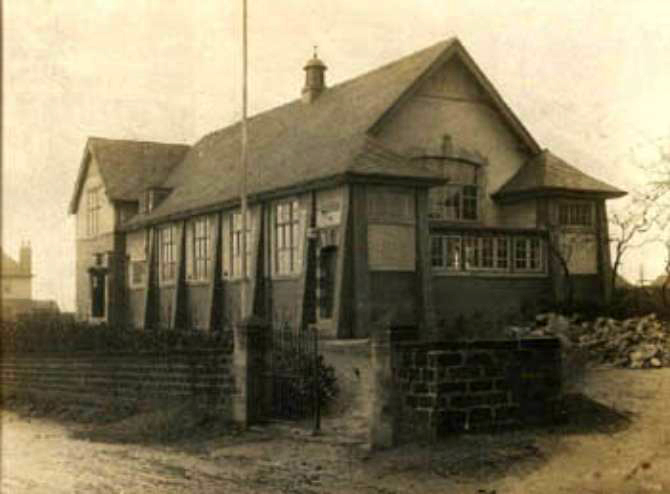
working, the church was closed for one year and the school on South
Hiendley common became the place of worship. The incumbent was Rev William
Knight who became leader of the committee appointed to supervise the
restoration, which consisted of twelve parishioners. The architects were F
and W Healy of Bradford and it is to them that a debt of gratitude id due
for the manner in which the building was restored as near as possible to
its original form.
The main walls were found to be safe and in a good state of repair but the
roof however was in a very unsatisfactory condition and was renewed. The
galleries were removed and holes in the walls and pillars, where joists
had been fitted, were filled in with suitable stonework, the ugly brick
wall forming a vestry where the Lady Chapel now stands was disposed of.
The chancel furnishings for the choir were made of oak as the pulpit and
that beautifully carved Lectern all of which exude the fine workmanship of
the artisans. The stone which once stood in the centre of the chancel was
removed in favour of a coke fired boiler, which stood under the nave and
provided central heating for a much larger area. A corona was made by a
London company and suspended from the chancel ceiling to provide either
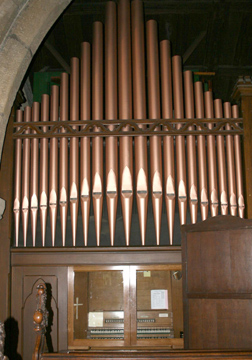
oil or candle light. It would not be right if I didn’t mention the
beautiful organ purchased and placed in its present position and in
excellent condition today (see photograph below left) Neither must I forget to mention the 900 years
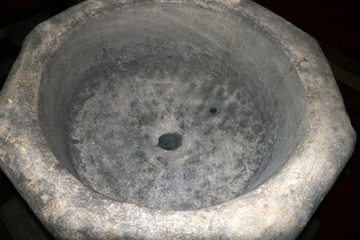
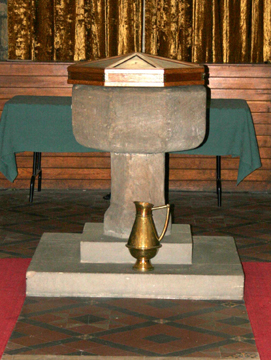
old font (see photographs below middle and right) which was nearly lost forever during the restoration. It would
appear that this unpretentious font was considered to be of no further use
and that something a little more in keeping with the furnishings should
replace it. So it was decided to sell or give it away to a local farmer as
a water trough and to build the pedestal into the church boundary Wall and
replace it with another more attractive one. This was done I suppose in
good faith and this ancient piece of carving was lost for sixty years
until by a strange coincidence both pieces were found during repairs to
the tower in 1932. But that is another story.
What about the cost of this work/? This was, so I understand, estimated to
be £1,600 and £500 was borrowed from the bank and guaranteed by the Rev
Hoyland, Rev Knight, Richard Day and Thomas Dymond. Apparently there used
to be a letter stating that their balance was paid in full by
subscriptions from the public and the church was reopened in October 1876.
The
next major repair took place in 1932 to the tower, which had badly
weathered at the top during its lifetime. The work was carried out by
Hepworth Brothers of Sandal and Crofton who replaced the top few feet and
more than a hundred wall stones as well as new tracery in some windows.
The north eastern gargoyle was replaced after being carved by Arthur Price
the gentleman who rediscovered the ancient font. Arthur also was the man
who rediscovered the great west door, which had been sealed up in protest
by the monks of Nostell Priory following a dispute with archbishop Walter
deGrey about 1251AD.
I must mention that after cleaning, the
old font was restored to its rightful position under the tower, where it
stands today, and the one, which replaced it, was given to the new church
just being built at Lupset. My neighbour and I went to see the “usurper”
just a few years ago and although it was well carved in a white stone it
was definitely out of place in Felkirk.
I would like to think that gas lighting was installed very
early last century but I cannot say with any certainty that it was. Never
the less I have a photograph of the interior showing what are suspiciously
like gas lamps suspended from the roof. Electricity was brought to the
building in 1955 the cost being borne generously by Mr Herbert Oldfield’s
family as a tribute to him following his death. Mr K Watts purchased a new
central heating boiler in 1983 in memory of his wife Ethel Elizabeth.
Perhaps without the generosity of these people and many, many more patrons
of this church, there would not be such a beautiful old building to write
about.
Back to Top of Page
Back
to
LOCAL HISTORY ARCHIVES
index
|