Question from Sandy
Wade-Gery who lives in Bedford February 2006
My
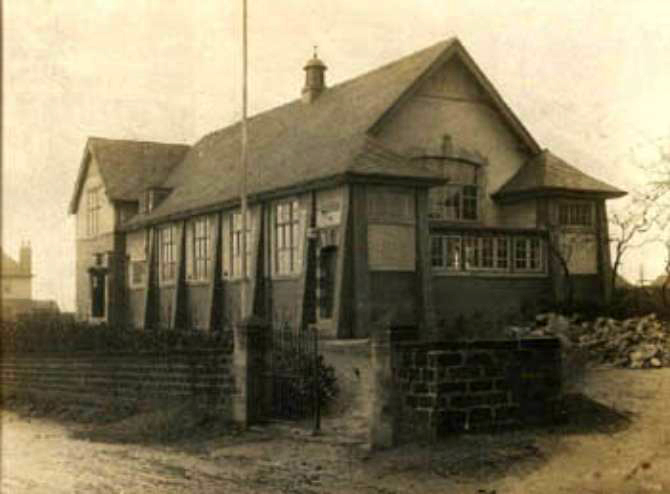
mothers father (John Dymond) my Grandfather lived at Burntwood Hall.
I popped in there on
the way home to Bedford the other day to see the place after an absence
of 50 years! The Manageress Ms Angie King asked me to help with some
local history as she loves working there and wants some info about the
place. It was quite moving for me as I had many boyhood memories and of
course remembered the famous authentic secret passage! Naturally it has
changed and no longer looks so grand as I remember but at least somebody
has found a use for it. The inside main Staircase and Library and Atrium
room, Drawing room ceiling still look fantastic. I understand a TV
company want to use it for their show background. My ancestors I believe
ran a mine and there was a terrible accident where Dymonds hair went
grey after days under ground trying to help/save his men.
My Mum is still
alive (95) and is bright as a button!
If you (or
anyone) can help with some history especially some of the old characters
that would be so good?
Regards
Sandy Wade-Gery
Bedford
Reply from Richard
Dear Sandy
Your contact has
prompted me to revise the Dymond family notes in my on line booklet
'Brereley a History of Brierley' which can be seen at
http://www.brierleyyorkshireengland.net
This is a copy of
the revised notes. I would welcome your comments
"Another early
family was the Dymond family as can be seen from the Manor records and
the rental lists. James ‘Dimond’ paid a ‘Freerent’ (Freehold?) of 1s 8d
for property in Brierley plus 4d for land called Mortenland in a 1662
rental. This same James is listed as living in Brierley on the 1665
Court Baron records. Also in 1665,
Thomas? Dymond a freeholder of Brierley was summoned to attend at
Ringstone Hill with the militia, to prepare for the Dutch Invasion,
Widow Dymond paid £10-15-00 rent to Brierley Manor in 1701.
Joseph Dymond was born on 5th December 1746. He was an
astronomer and mathematician. He accompanied the Prince of Wales on a
trip to Hudson Bay in 1766 and died at Blyth on 10th December. 1796.
James 'Dimond'
is named as a Brierley farmer aged 22 on the Staincross Militia List
dated 1806. In 1813 The Wesleyan
Methodists bought £5, a plot of land in South Croft from Mrs. Dymond.
On the tithe award survey of 1840 John Dymond occupied a farm on
the north of what is now Church Street Brierley where he lived with his
wife Mary three children and two servants. This was owned by the Manor.
John Dymond also owned a farm of 33 acres further west on the same
street.
By 1861 the family had moved to what is now Elms Farm on Common Road
Brierley. Here Mary Dymond aged 54 lived with her son Thomas who was a
land surveyor, James who worked the 102 acre farm, and her daughter
Elizabeth. The family built a row of cottages opposite this farm. By
1881 Mary Dymond was living on
Church Street.
James Dymond now aged 46 and a Coal owner was living with his wife Mary
and three children at Elms Farm. Thomas Dymond aged 48 also a Coal Owner
was living at Burntwood Hall with his wife Anne (nee Tomasson), and two
children.
Thomas Dymond was born in 1833 and lived to be sixty-seven years old. He
was the manager of the Barnsley Main Colliery Company. He was married
twice and his first wife. Elizabeth died in 1866 at the age of only
twenty-eight. His second wife named Anne outlived him dying in 1923.
Thomas Dymond bought Burntwood Hall about 1868 and it then stayed with
the Dymond family for almost a century. Burntwood has always been part
of Great Houghton but Thomas, being a Brierley man, had close
connections with the village. He was church warden for Felkirk and in
1876 gave three bells to
Felkirk Church
when the tower was restored.
Anne Dymond who was born at Penistone, was the aunt of Beatrice
Tomasson. Beatrice was born at Barnby Moor Nottinghamshire and lived for
many years in Gortnamona House Clontuskert Ireland, she came to live at
Burntwood Hall as governess to Anne's daughter Catherine. She later
became known as leading lady a mountaineer.
On the death of Roger Dymond in 1960, the Dymond estate was sold off.
Burnt Wood Hall is now the property of Mr. Douglas Ross-Gardner, the son
of a well remembered local doctor. Howell Wood is now the property of
the new West Yorkshire County Council.
Extra note
There is a family tradition that Thomas Dymond owned a colliery where
there was a disaster that deeply upset him and that his hair went grey
overnight. He is known to have been Managing Director of Barnsley Main
Colliery. Oaks Colliery was on the site of the later Barnsley Main.
There was a disaster at Oaks Colliery that claimed several hundred lives
on the 12th. -13th. December 1866. This made
national headlines at the time. It does seem possible that Thomas Dymond
could have been Managing Director 1866; it is the year his first wife
died. There is a memorial to the disaster at the top of a hill on
Doncaster Road Barnsley."
Reply from Sandy
Dear Richard,
Thanks for this
....most impressed.
My knowledge is a
bit hazy and I will print this out and show my Mother Mrs Margaret
Francis Wade-Gery (nee Dymond) who lived there with her father Robert
Dymond.
I have
difficulty remembering my own fathers’ family history which has been
centred here at Bushmead Priory since the 15thC
The sunken garden
she tells me the family called the Fairy garden and her father kept Bees
there. The locals were frightened to visit because of a particularly
vicious stinging Italian Queen Bee.
The secret
underground passage used to partly fill with water and then freeze in
winter making it difficult to walk through. During the war one of the
workers used to hide there with his family when the air raid sirens
sounded. (this amused the family as they considered the Germans hardly
likely to bomb a remote part of Yorkshire.
She also remembered
they made their own gas in a plant situated on the right hand side of
the driveway. The main garden stone wall needed constant annual
maintenance because of the soft stone!
Her father John
Dymond created a written work called Dymond on Death Duties which is
known by all Legal firms who have an updated copy in their
libraries....his eyesight suffered during this work and she helped him
to finish it.
They
used 5 watt bulbs in the hallway which seems incredibly poor lighting
The
Forester known as Heaton worked across the Estate and the Woodlands, Ice
House and Lakes....he sadly committed suicide after the Dymonds left and
somehow tied his feet together so this would facilitate his removal from
the Lake!
Lots of snippets
some rather morose but nevertheless interesting!
Regards
Sandy