One
of the earliest references to the Hoyland family living in the Barnsley
area is that of one John Hoyland of Wolsley Croft, Hemingfield, in 1627.
Following the branches of the family tree, the first connection we have
to Brierley appears to be another John Hoyland listed as a resident on
the Brierley Manor Court Roll for 1665. He may have been the father of
John Hoyland who died at Brierley in February 1732.
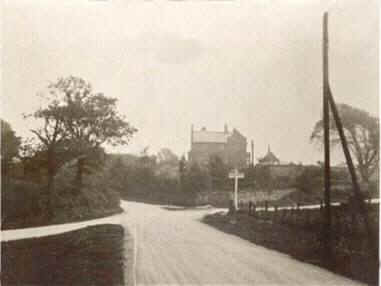
Photograph on the right shows Brierley Gap
before the road was extended - date
unknown
There were quite a few Hoylands in the district from this date and
further information on the family can be seen in Richard Watson -
Mary Harrison’s book
Brereley a history of Brierley. Indeed, there is a record
of a Miss Sarah Hoyland born in 1830 who resided at Lindley House, who
married, in December 1855, the Rev Godfrey Pigott Cordeux, who later
became the first curate of St Paul’s Church. The corner which Lindley
House stands on still carries the name Cordeux’s corner.
Another
John Hoyland, referred to in the archives as the ‘elder’, must have
purchased land at Brierley gap extending to five acres sometime during
his life, for in his will dated 1871, he mentions the possession of this
land and as executor of his estate appoints his son, the Rev. John
Hoyland who was vicar of Felkirk at the time.
History
In
1903,
the
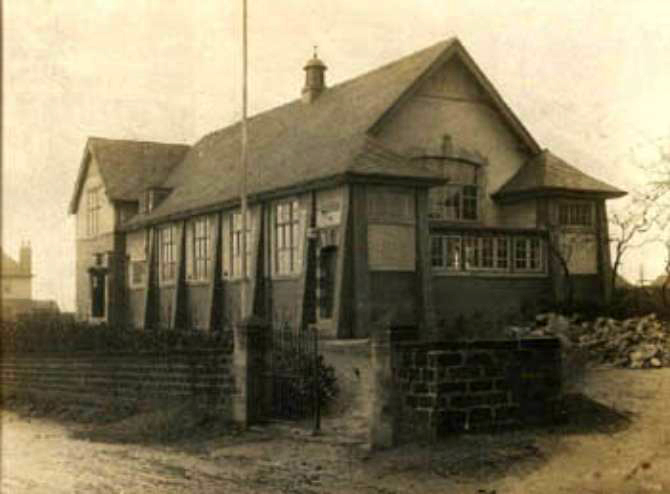
Rev. John Hoyland conveyed to his son, Clement Edward Hoyland of
Cumberland, a piece of land at Brierley Gap, which measured five acres.
He erected property there in the same year and it became known as
“Brierley Gap”, better known today as the Robin Hood. Their stay
there however was short lived, and on 16 March 1911, just eight years
after having the property built, it was conveyed by the Hoylands to the
Hemsworth Rural District Council.
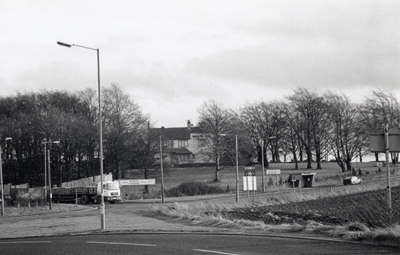
Brierley
Gap taken by Baipip in 2000. Now the Robin Hood.
Part
of the old road can be seen as a path in the middle of the photograph.
The
Rev. John Hoyland died in 1910, and after his death, his widow Mary Ann
Hoyland who was residing at Brierley Hall at the time, went to live in
Harrogate (see history Brierley Hall), these being the parents of
Clement Edward Hoyland, it is possible (and purely speculation on my
part), that on the sale of the property at Brierley Gap, Clement
followed his mother to live in Harrogate (see update below) as nothing more was heard of
him, or indeed the Hoyland family.
Hemsworth
Rural District Council used the property as a home for the nurses
working at the fever hospital nearby (now Burntwood sports centre), and
also as a sanatorium. In 1964, they conveyed the property to Brierley
Gap Holdings Limited with Mr W Child as chairman of the Board of
Directors. It was converted into a gambling casino ideally named “The
Five Acres Country Club”, and some time in the seventies, it became
the first night club Brierley had ever hosted. It was aptly named
“Eight Miles Out”, the reason being that it was approximately eight
miles from Barnsley, Wakefield and Pontefract.
The
property still stands proud today and local lad Roger Butterworth, now owns
the property which is known today as “The Robin Hood”.
More
detailed information on the Hoyland family can be seen in
Brereley a history of Brierley.. Richard Watson and Mary Harrison 1975/76.
Although the book sold over 2,000
copies and is no longer available, Richard has an updated version on
floppy disk, or you can read the full book on his web - site
Update March 2009
This email was received at the web site
which confirms my thoughts that
Clement followed his mother to live in the Harrogate area although it
does seem to be Evington near York.
My name is Shelly and I live in
Evington nr York. I am building a website about the history of the
village and I would like to confirm that Clement E
Hoyland lived here in 1928. He bought
a property called Brinkworth Hall, and donated the organ to the
church. I have a copy of land search for 31st July 1928 for Clement.
If you would like a copy please email me and I will send you it.
Would it be possible to use some of your info on the Hoylands on my
site?, if not I will place a link to your site
Local History archives
index
|